Wednesday, 21 August 2024

Samsung Galaxy Z Flip6 - No More Pain Points

You know what? I'm thoroughly sick and tired of hearing about AI. How about you?

As a tech reviewer, it's everywhere I look. If it's not baked into the NPU of a phone, it's part of a computer's operating system. TVs are using it to adjust the brightness. Earbuds are listening to the noise around me and deciding which sounds are the ones I actually need to hear.

Great.

Fantastic.

The future is now.

Big whoop.

Can we talk about something else for a minute?


Admittedly when you look up the Galaxy Z Flip6 on the Samsung website, the first thing they tell you is, "Galaxy AI is here." And yes, the Z Flip6 can do pretty much all of the clever AI tricks the Z Fold6 I reviewed a couple of weeks ago can. Yes, it'll do live translation in 16 languages on both internal and external screens, as well as spoken translations in real time. Yes, you can "Circle to search" and yes, you can use Galaxy AI to compose messages and emails in a number of different styles. And yes, you can put real sunglasses and a silly hat on a picture of your dog, just by doodling them on the screen with your finger. Cool.

Cool.

So cool.

Now we've got the AI stuff well and truly out of the way, I want to talk about some features that are more specific to the Z Flip6, namely some issues I've had with previous generations and whether or not Samsung has done anything to address them on the 2024 version.

Let's start with the physical design of the thing. It's great. As I mentioned with the Fold, when these new, bendy phones first popped up a few years back it's hard to deny there was a certain janky-ness to them; they didn't fold together completely flat, the frames and bezels were clumsily thick and you essentially felt like you'd better treat these devices with kid gloves or they'd break into several pieces if you weren't careful.

We're well past that now.

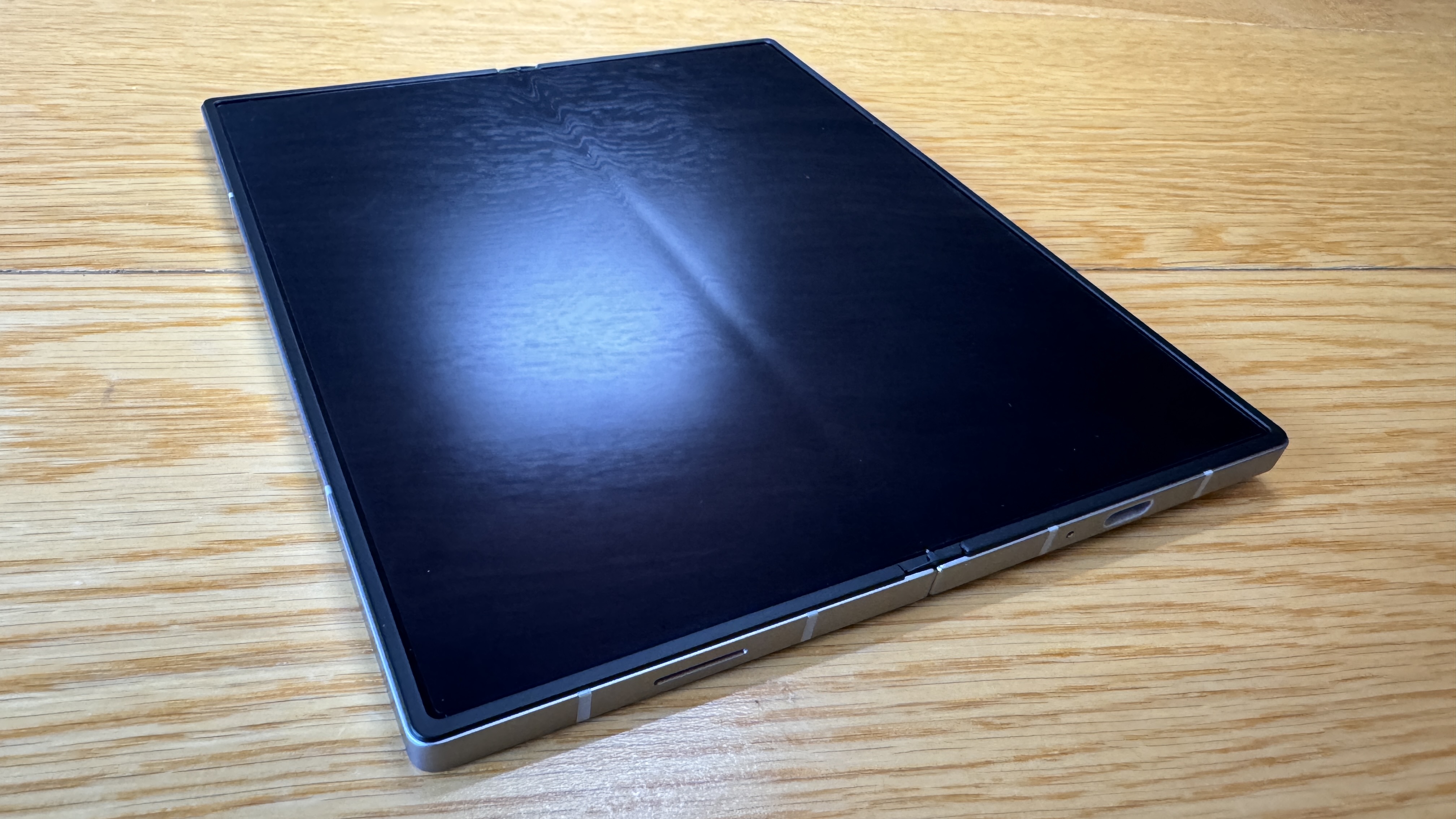
There's a solid durability to the feel of the Z Fold6 in your hand. Closed, open or in Flex Mode, it looks stylish, premium and built-to-last. Once again, Samsung has upgraded its hinge design and it's now at the point where you don't even really think about it that much when handling the device. Very secure. Unfortunately, there's still a mysterious groove around the edge of the internal display between the mandatory screen cover and the slightly-raised and rubbery bezel that keeps everything sealed tight when the phone is closed. I've found this becomes a bit of a trap for dust and other debris if you're not careful - in fact, somehow I seem to have got what looks like chocolate stuck in one corner. Goodness knows how that got there.

However, although the Z Fold6 may not be chocolate-proof, with an IP48 rating it is more water-resistant than ever. This is not the pool-proof IP68 level of protection the Galaxy S-Series phones carry but it's an encouraging improvement and means this handset should survive rainy walks and the odd splash or two.

It's also touted as being more compact than ever and it certainly feels just like any other phone when unfolded (unflipped?) and slides easily into any of my pockets when snugly closed up.

Another issue many people (including me) have had with Flips of the past is battery life. Given this is a device aimed at vloggers, streamers, sharers and influencers, you'd expect pretty high screen time and camera usage numbers. For people like that, only-average battery life becomes a problem by the end of the day. Again, Samsung has attempted to right this wrong with a bigger battery and a more efficient chip. In my real-life usage I can't say I've been blown away by significant power savings. Compared to other flagship phones I've reviewed lately, the Z Flip6 is definitely well below 50% by the time a get it on the charger at night. I will concede though, this is an improvement on previous Flips - some of which required mid-afternoon top-ups to see me through.

The external or preview screen has been another niggle for me. Not just its weird shape either; I mean, what exactly are you gaining with that extra little bit beside the camera lenses? I'm talking about its limited functionality. I know it's small but I'd still like the option of trying to use it as a fully functioning display. Instead, you only get notifications and a choice of smartwatch-style widgets to scroll through. Yet again, I have to admit, improvements have been made. There are more widgets (and more useful ones) now and you can set up quick replies for certain messaging apps. That's a good start but I still want more. And how come the display doesn't rotate? It's basically square, so it shouldn't matter which way I hold it up, surely.

Okay, of course it does that other thing... the really cool thing... It gives you a preview of the primary camera so you can take selfie pics and vids with the main camera.

And that has suddenly become even more of a feature than ever before because Samsung has well and truly sorted out the biggest Z Flip shortfall of the past; camera quality. The 12MP Ultra-wide has been updated but the big news is the main Wide-angle camera has gone from 12MP to 50MP. This means a real coming-of-age for this handset; super-clear, hi-res, vibrant shots - even from distance - thanks to the new 2x optical zoom. And although I wasn't going to mention it again, when it comes to the camera, it's hard to avoid AI - especially when it comes to assisting with auto-zoom, night shots and video HDR.

Finally the Flip has the camera it's users have been demanding. As an example, check out this tricky shot with problematic bright backlighting...


Now zoomed in...


These are photos that just wouldn't have been possible on previous Flips.

So...

I guess you could indeed argue Samsung has made most of my pain go away. But at what price? Answer; about 220 bucks. Yup, the Z Flip5 is NZ$1,879.00 while the Z Flip6 breaks the 2K barrier at NZ$2,099.00. Ouch. And yet...

Better design. Better cover display. Better battery. New chip. More RAM. And unquestionably improved camera performance. Maybe this is a two-thousand dollar+ phone after all.


Tuesday, 13 August 2024

motorola edge 50 pro - Bringing Sexy Back

At the start of the year if you'd told me one of my favourite phones of 2024 would be a Motorola, I probably would have laughed and asked for another round of whatever you were drinking.

That may sound harsh but although Motorola has been doing mobile phones longer than just about anyone, I haven't seen too many flagships with all the bells and whistles lately.

Enter, a flagship with all the bells and whistles... and I do mean ALL...


The motorola edge 50 pro (they seem to market it in lower-case, so I'll follow suit) is a thing of beauty. For a while there, all the flagship phones had curved-edge displays like this and I was a massive fan. In fact, I'm a fan of curves in general. Who wants sharp edges and pointy corners when you can have the comfort of a curve in your hand? It just seems more streamlined - more stylish somehow.

Not only is the edge 50 pro curved at the sides, the back panel also sweeps up to the rear camera module in a delightfully seamless way. While there are pearl-like, smooth-backed options in other colours available in overseas markets, here we're only getting Black Beauty, in a matte, vegan leather finish - and I couldn't be happier about it.

There are two main problems with a phone as slim and curvy as this. Firstly, if it has a shiny glass back it may be pretty but it'll also be slippery. This vegan leather variant keeps the handset firmly gripped in your hand - and also prevents unsightly smears and fingerprints.

The second edge-centric drawback is the "accidental touch issue" and I'll admit, that is still a tiny niggle with the edge 50 pro.

If you've used a curved display like this 6.7-inch, super-HD screen before, you've probably found yourself stabbing away at an icon or virtual button wondering why nothing's happening - only to realise because you're holding the edge of the screen as well, the phone thinks you're touching it in several places at once. This really isn't a massive hassle - especially once you know it's a possibility - and it's only happened a few times since I've been using it.

My real problem with the edge 50 pro is trying to find something wrong with it.

At NZ$1,099.00, it's right in the zone where other phones usually leave something important off to keep the price down. Not this time. IP68 water and dust resistance? Check. Triple-lens rear camera array with 3 X optical zoom? Check. 4K video capture? Check. Support for NFC and eSIM? Check. Case included in the box? Check. Wireless charging? Check.

What's more, it charges fast, thanks to the powerful 125W charger that also comes in the box. Battery life is up there with the best performing handsets I've tried as well.

This is probably partly due to the efficiency of the Qualcomm Snapdragon 7 Gen 3 chip running the show. In the video below, I rather unfairly refer to the 7 Gen 3 as "last year's chip," which is not really accurate - it's more like this year's 8 Gen 3's smaller sibling; ever so slightly slower, especially when it comes to operations like down and uploading.

However, unless you were to compare two phones with these two chips side-by-side, I really don't think you'll be disappointed with the performance here. I know I haven't been.

For example, the camera app opens straight away and works without any lag or stutter, no matter which mode or setting you choose. I've been very happy with my pics to date, be they ultra-wide landscapes like this...


Or making use of the 10MP telephoto lens for shots like this...


Not only does the edge 50 pro come with all the features I want in a phone, right now it also comes with a free pair of moto buds+ true-wireless earbuds.

Like the handset, the moto buds+ are premium performers, again ticking most - if not all - of my ear-wear requirements. Top notch battery life, from both the case and the buds themselves. You can charge the case wirelessly. The buds are water resistant and thanks to the selection of ear tips and the stem design they're great for exercising with.

The moto buds+ are tuned by Bose and the default sound is very clean, leaning towards a little dry - although you can adjust the EQ via app or let AI manage it for you, depending on what's playing. You also have the options of either Hi-Res mode for discerning listeners or Gaming mode for less latency.

My one major criticism is the on-board touch controls. These are customisable to a degree but there's no single tap - only double and triple taps or a long press. Although this obviously eliminates accidental play/pause presses when inserting or removing the buds, it's weird not to be able to resume listening with a single tap. And you can't assign the volume controls to the long-press function either - which also seems less than natural. Maybe it's just a personal preference.

On the "Plus" side, the bass response is impressive - especially for earbuds - and I've also been blown away by how strong and reliable the connection is. I can leave my phone on my desk and keep listening all over the house.

Remember, you get the moto buds+ for free when you buy the edge 50 pro, which I already considered fantastic value for money.

Unlike other 2024 flagships, Motorola doesn't seem to be making much noise about AI, although something called "moto ai" seems to be responsible for a lot of the edge 50 pro's photographic and cinematic tricks. I'm a fan of this more low-key approach - it's only August and I've already had more than my fill of AI hype for one year. At least with this phone, Motorola seems content to let AI do its best work mostly unseen, in a more integrated, under-the-hood way.

I could spend all day singing this phone's praises but let's just say my usual approach when reviewing a device hasn't quite worked this time. I usually ask myself, "What's wrong with this phone? Where does it come up short? What more could it do?" When the answers to those questions are, "Nothing," "Nowhere" and "Not much," then there's not a lot more to say.


Thursday, 18 July 2024

Samsung Galaxy Z Fold6 - This Finally Feels Real

Although still not exactly commonplace, foldable phones are no longer quite the sensation they used to be. While Samsung initially led the way, other brands have quickly jumped on the foldable bandwagon - especially in other regions around the world.

And yet, until now, even I (self-confessed tech nerd and confirmed early adopter) have felt a little uncomfortable using the bendy form factor. It's always seemed a little too experimental, too fragile to justify the high price tag. Especially when premium features like hgh-end camera hardware and durability certifications were compromised in favour of a folding screen.

After a week or so with Samsung's latest folding flagship though, I think I'm starting to come around.


Critics have branded the Galaxy Z Fold6 as another iterative upgrade, not so different from the generations before it but I couldn't disagree more. From the moment I first held a Fold6 I was struck with how much more finished it felt in my hands.

For the first time this extremely expensive phone (starting at NZ$3049.00) emulates the same sharp lines and and luxurious feel of its Samsung S-Series stablemates. Available in Silver Shadow, Pink, Navy and the exclusive (and kind of boring) online-only shades of White and Crafted Black, there should be a colour to suit most tastes.

Also for the first time, the hinge has been modified to allow both halves of the internal display to shut completely flush against each other - they said the Fold5 did this last year but I reckon there was still a bit of a gap. This is a biggie for me because I tend to keep my phone in my pocket and previous Folds have always ended up with their screens covered in dust and lint - that problem has been completely taken care of here.

This is the thinnest and lightest Fold yet - and I definitely noticed the difference. It's the difference between clunky and elegant. This comes with quite the durability boost too; Armor Aluminium edges and Corning Gorilla Glass Victus 2 make for a stronger device and Samsung has even improved the water resistance rating. This all helps with piece-of-mind given the hefty sticker price.

What's more, because of the new, sharper corners, there's slightly more usable display, both inside and out.

In saying that, the exterior screen has kind of hit its usefulness threshold. Oh, don't get me wrong, it's a gorgeous, 6.3-inch dynamic AMOLED panel and in most ways it works every bit as well as the display on any other premium Samsung device. In fact, I'd say I use it far more than the internal, folding or "Main" display... although that just might be me still learning to use the Fold6 better.

What I mean about that "sub display" being limited is due to its aspect ratio. As one half of a larger, almost square device when unfolded, it's very long and narrow. This not only makes typing on a small, skinny keyboard a bit hit-and-miss for my clumsy digits but when rotated to landscape, everything tends to get squashed out flat and wide - especially the widgets I've added to my home screen.

By stark contrast, the internal screen feels like a breath of fresh air when unfolded to its full 7.6-inch glory. There's plenty of room for everything - from icons, to browser windows, to games, to video. Apps you can split into two views - like Outlook - were just waiting for a form factor like this to come along.

But we know all this already. I've told you myself. We've already seen cool tricks like using the outer display as a preview screen so you can shoot selfies with the primary camera.

For some reason, Samsung is still persisting with the 4MP Under Display camera inside the Fold6. And for some other reason it's still in the weirdest place; above the right-hand side of the display - that's if you happen to be holding it that way around. Surely if you're resorting to using this camera at all (and the only reason I can think of is for online meetings) you'd be more comfortable with the phone in its half-flexed position, sitting on the desk in front of you in which case the more logical position for this strange selfie cam would be halfway along one of the longer edges. I really don't get it - even after six generations.

In fact, there hasn't been much of an upgrade in camera hardware here; still a 50MP wide / 12MP utra-wide / 10MP telephoto configuration for the "rear" primary shooter but that's better than you'll find on most phones.

However, in what is probably a trend for the future (and has definitely been the theme so far in 2024), the majority of the buzz with Samsung's new folding flagships is all about AI.

With the S-Series launch earlier in the year, Samsung revealed how Galaxy-AI was now powerful enough to perform a raft of both fun and useful photo editing tasks as well as some very impressive on-device translation.

When this same technology is combined with a folding screen and a secondary display, Galaxy AI really starts to wow the crowd. If you've ever tried doing much video or photo editing on your phone, you will have undoubtedly encountered the frustration of doing so on such a small screen. This is where the huge display of the Fold6 really comes into its own, especially with the enhanced editing capacity of Galaxy AI.

Simply place your finger on an object in your photo and you can move it, copy it, erase it, enlarge it... there are a lot of options.

Portrait Studio is more than just a library of filters, it'll create surreal caricatures in a range of artistic styles.

Sketch to Image lets you doodle your own enhancements onto a picture, (with either a stylus or just your finger) then Galaxy AI will grab actual images to replace your rough drawings - and believe me, my drawings are rough.

You can even add slow-mo sections to videos you've already recorded. 

As a creative tool, no other phone has ever been this useful.

And as a communication tool, it's even better. 

The S24-Series phones saw the introduction of Galaxy AI-powered live translation tools. Again the Fold6 takes this even further. Now you can type or talk using the internal screen and within seconds a translation will appear on the external display and your words will be spoken in the alternate language of your choice. Because you download the language packs you require ahead of time, all this happens on-device, using the built-in Neural Processor - so when travelling, you can literally chat with the locals without even having to use a data connection.

These same Galaxy-AI listening skills are also put to good use when it comes to taking notes, summarising dictation or even asking for more information about whatever you're looking at on screen. 

You won't have any trouble reading that screen either; both inner and outer displays are dramatically brighter than previous generations. Combine that with the ease and power of the Snapdragon 8 Gen 3 Mobile Platform for Galaxy processor and suddenly your gaming experience is next level.

A more efficient processor and a new vapour chamber to keep things cool has meant a noticeable bump in battery life too.

All sounds pretty good, right?

So here's my question; Does it sound a thousand dollars better than a non-folding flagship handset? If it does, then perhaps I was a bit hasty with my earlier criticism of the price. At first I thought there was no way you could justify that much money for a single phone. But then I held it. And I used it. And for the first time it felt like a finished, polished, useful and reliable device - not just a gimmicky flex.


Click here for more information and pricing on the Samsung Galaxy Z Fold6.

Sunday, 14 July 2024

Oppo Reno12 Pro - Playing with the Big Boys

The title of this review must seem a bit strange to anybody reading from Europe or Asia. Although Oppo is a massive player in many regions, by the end of last year it accounted for less than 10% of the market here (according to a March 2024 report by the New Zealand Herald).

No prizes for guessing the big two brands battling it out for top billing at around 40% each. Still, although a fair distance behind, third is still third and Oppo has managed to claim that spot over the last few years with a consistent line of reliable, well designed handsets boasting excellent battery-life, market-leading fast-charging and camera technology that rivals the very best around.

So what have they done for us lately?


In New Zealand, the Oppo Reno12 Pro comes in two colourways; Nebula Black or Nebula Silver. I was sent the black version to review which features a matte finish over the top eighty percent of the rear panel, with a glossier section below the Oppo logo - all with a slightly purplish hue to it. The Nebula Silver is much more eye-catching - more shiny with a wave-like pattern that seems to shimmer in a 3D way.

As I removed it from the box I was struck by how slim and light the Reno12 Pro feels - it slips very easily into my pocket yet its beveled edges make it secure enough to grip without a case. The other item of note in the box is the charging brick - notable not only because you actually get one with this phone but also because it's a legendary SuperVOOC charger - this time delivering an insane 80W to have the phone juiced up in no time.

In fact, I wouldn't usually give a phone like this much consideration as my primary handset based solely on the fact it has no wireless charging. However, the Reno12 Pro charges so quickly and the battery lasts so long (it gets me through two days of heavy use without coming close to going flat) I'm prepared to make an exception.

Part of the key to this impressive power-efficiency must be to do with the MediaTek Dimensity 7300-Energy chip running the show. I'm not particularly familiar with this CPU although I've been reading a lot of favourable reports about the latest chips MediaTek has been supplying. Certainly this phone blazes through its work, thanks also to the 12GB of RAM and 512GB of internal storage.

At NZ$1099.00, good luck finding another phone with that much storage anywhere near that price. These days I'd argue if you shoot any amount of pictures and video at all, 512GB should be your starting point. The Reno12 Pro makes that starting point a lot more attainable.

Speaking of photography, the Reno12 Pro wouldn't be an Oppo phone if it didn't have a great camera setup and there's no doubt this array is up to the task. Dual 50MP wide and ultra-wide lenses combine with an 8MP telephoto sensor to provide high-level performance at a mid-range price.

Check out the detail captured in both the foreground and distance in this shot, looking almost directly into the sun...


There are also some pretty nifty AI tricks at hand that seem to emulate what we've seen from some of the other "flagship phones" over the last year. Here's a sunset shot I took using night mode.


But then I decided I didn't need the couple sitting on the electrical transformer box at the left side, so I AI-Erased them out...


Or maybe you want to take the world's cutest dog...


And stick him somewhere else. The Reno12 Pro can do that too.

Other AI tools allow portrait touchups of group shots and opening the eyes of that one person who always seems to blink just as you're taking the shot.

Oppo uses AI to keep your phone connected when swapping between Wi-Fi and 5G the dictation and summary tools suddenly seem to be standard offerings on all AI-empowered devices.

Sadly, the Reno12 Pro is not eSIM-capable. I found this a bit of a surprise, given this seems to be more the norm than the exception with new phones these days.

On the plus side, for the first time I can recall, Oppo is being much more upfront with the durability claims. The Reno12 Pro is now more than just splash-proof - it carries an official IP65 water/dust resistance rating. Oppo also claims it's been tested to resist extreme temperatures and high humidity, not to mention being run over by a 3-tonne vehicle! (They mean the equivalent pressure on that last claim - as long as the phone is face down. Still pretty wild and no, I'm not going to try it.)

Not only is there physical, shock absorbing cushioning built into the high-strength alloy chassis, you also get Corning Gorilla Glass Victus 2 covering the display. Again, this is a very high-end feature more likely found on flagships twice the price.

And I think that's the nice little niche Oppo has found itself in the Kiwi market... If you're willing to forego eSIM and wireless charging you'll get a hell of a lot of phone for around a thousand bucks; outstanding battery life, super fast charging, great photos and a host of AI tools that aren't just clever, they're genuinely useful too.


Tuesday, 30 April 2024

Motorola moto g34 5G - Some Phones Just Feel Nicer

Over the years I have become a real phone snob. It's not my fault. When you review phones all the time you get to try the latest and greatest and that means you miss all those premium features if your daily handset doesn't have them.

Do I actually need a phone with a terabyte of storage, wireless charging and the ability to be dropped in the ocean and survive? Probably not.

But knowing there are other people out there using phones like that... well that just drives me crazy.

So it's easy for someone like me to slip into the mindset that no phone under $2000 is even worth taking out of the box.

This is, of course, ridiculous. Every now and then I need to give myself a couple of uppercuts, take a reality check and see just how far down the price-range I can go while still getting what I really need from a phone.

Turns out, it's pretty far.


The Motorola moto g34 5G retails for NZ$319.00. That's ten times less expensive than some phones I've reviewed.

Okay, I'm exaggerating. It's actually more than ten times less expensive than some phones I've reviewed.

And yet, I've been using it for a week or so now and you know what? My life is not ten times worse as a result. In fact, you could argue things haven't changed much at all.

But I'm getting ahead of myself.

Ironically, unlike many far more expensive handsets, the moto g34 ships with a 20W charger in the box. The bigger irony is the moto g34 is possibly the first phone I've ever reviewed to be packaged already in its included case. Don't get me wrong, I love it when a cover is included. Sure, it's a relatively basic, transparent TPU case with opaque edges but that's better than no case at all... Except... This phone has a vegan leather back which feels absolutely incredible in your hand. There's no way I'm depriving myself of that tactile experience by tucking it away in a plastic case.

I absolutely love holding this phone. There's a slight catch - in order to get vegan leather you have to opt for the Ocean Green variant. If you prefer the Charcoal Black option alas that only comes in a smooth, acrylic glass finish.

Either way, the handset is light and slim - the display is large but in a tall and skinny way which makes the phone easy to operate with one hand. It's a 6.5-inch LCD panel with a 120Hz refresh rate - I don't love an LCD screen on my phone because means it's hard to see when I'm wearing my polarised sunglasses however, that high refresh rate certainly belies the budget-friendly price-tag.

Which hints at quite a list of other "premium" features I was surprised to find... like NFC payment, a stereo speaker array and eSIM capability. Get used to this last feature - in places like America, many phones are now eSIM-only. However, this one still accommodates dual physical SIMs as well and you can add a microSD (up to 1TB) for extra storage space.

There's already 128GB built in - which is pretty much my bottom line for any phone now, otherwise you'll be scratching around for space to store your high-quality pics and vids.

I would have also said 8GB of RAM is my bare minimum these days but the moto g34 only rocks 4GB. Luckily, thanks to RAM Boost, the phone can use some of the available storage as virtual memory. This seems to work surprisingly well and while this is no gaming powerhouse, the only time I've experienced any major stutters or slow-downs is transitioning in and out of the Camera app.

Which is not to take anything away from the camera performance as a whole. Again, because of the moto g34's low price, I was bracing myself for substandard photo and video performance in anything but the most ideal of conditions. Yet sure enough, my expectations were exceeded by quite some margin. The moto g34 performs quite well in dim lighting and generally produces clear, bright, colourful shots.

Both the 50MP primary shooter and the 16MP selfie-cam consistently came up with the goods - it's always those split-second, spontaneous shots you only get one chance at that are the true test of a phone camera's performance. I thought this one of my "Wine-ing" dog came out pretty well.

Back to the camera app - although the phone is a little sluggish swapping between its live view and the camera roll, yet again there are some nice-to-have features here that actually work. There's a Dual Capture option that lets you shoot from both front and rear cameras simultaneously and there's even a Magic Eraser tool which I used to blot out a distractingly over-lit leaf on the right of this bunch of flowers.


I'm not much of a fan of macro lenses though - especially 2MP sensors like the one on the back panel here. We often find macro lenses like these on budget phones and I don't really know why - is it just to make the camera array look more impressive in a bit of "two lenses must be better than one" logic? Doesn't really bother me given the overall camera performance here is well above average - even the portrait shots I took looked pretty good to me.

Battery life is excellent. The 5000mAh cell gets me through two days easily, although that 20W charger doesn't juice things up particularly quickly. Unfortunately, wireless charging is one high-end feature this phone does not have. While that's a deal-breaker for me, most "normal" people don't seem to mind plugging in.

The moto g34 is also described as "water repellent". It's hard to know exactly what this means as it doesn't carry any IP rating and it certainly isn't submersible. I think the idea is it won't matter too much if you sweat, get rained on or accidentally spill a drink in its vicinity.

As for the My UX operating system, built over Android 14 - it's so stripped-back, it's barely noticeable - and that's just the way I like it. Most features and settings are easy enough to find and customise, although because of the display's tall 20:9 aspect ratio, there's only room for four icons across the home screen. It's a small niggle, but when you're used to five it's a tough decision which app you'll lose from your favourites bar at the bottom.

I'd like to be able to comment on the fingerprint and face unlock functions but for some reason my loan agreement forbade me to set these up so maybe they work, maybe they don't.

What does work is everything else - and it all works well. I never thought I'd be this satisfied with the performance, camera setup, look and feel of a sub-$350 handset, and yet, here I am. This is a phone that fits very nicely in my pocket.


Click here for more information on the Motorola moto g34 5G.

Tuesday, 26 March 2024

Samsung Galaxy A-Series (2024) - Spot the Difference

It's that time of year again... when it becomes a real challenge to understand the difference between all the phones Samsung has to offer.

By now the three Galaxy S24 flagships are well and truly out and about. They're pretty pricey though, so you might be considering the S23 FE from late last year as a more budget-friendly alternative.

Of course, if you want something bendy, the Z Flip and Fold are both great options, although there'll be new models out in a few months time.

And as if things weren't complicated enough, the 2024 A-Series has just hit the shelves. That's another six phones to add to the mix. Oh boy.


Samsung loaned me an A55 and an A35 for this review and i can tell you straight off the bat, the only thing that would keep me from buying either one for my own personal use is a lack of wireless charging. I'm afraid that's become a dealbreaker for me which is a shame because wireless charging seems to be one of the first "premium" features to be sliced off the list when manufacturers design a sub $1000 phone.

This year's A-Series handsets almost make up for it though by supporting 25W fast charging right across the range. Both my review devices had excellent battery life too - coasting through two full days on a single charge.

Both the A35 and A55 carry an IP67 dust and water resistance rating - that's pretty unusual for a phone in this price range. 

What I found even more unusual was how good the camera quality was - in both devices. While these phones obviously aren't capable of producing the unrivalled photo and video performance of their S-Series big brothers, they don't fall too far short. The main difference between camera arrays is the A55 has a 12MP Ultra-Wide sensor, while the A35's is only 8MP. The A55 also boasts an impressive 32MP selfie-cam, as opposed to just 13MP on the A35. That said, both rock a decent 50MP main shooter and both sport fairly advanced features like Super HDR Video, both optical and digital image stabilisation and advanced "Nightography" for better low-light shooting.

Neither device really offers the advanced on-device AI processing Samsung was so emphatic about with its S-Series launch at the beginning of the year but if you can do without live translation and AI-assisted Google searches, you can definitely save somne serious cash and still end up with a very decent phone.

At $NZ799.00 the A55 comes in Awesome Navy or Awesome Iceblue (which is really white with a slightly blueish tinge). It feels evey bit as premium in the hand as any other flagship that sells for more than twice the price. This is thanks to the glass back, metal rails around the edges and upgraded durability for the glass over the display.

Although the NZ$649.00 A35 is essentially exactly the same shape and also comes in Awesome Navy, its other option is Awesome Lilac and while it still has a glass back, the sides are plastic instead of metal. As you would expect, the chip on the A35 is a step down from the A55... but not that far down. In fact, it's the same chip that ran the A54 last year.

Confused yet? I don't blame you.

Perhaps the most confusing thing of all is although both these phones cost less than half of their S-Series stablemates, they're way better than half as good. I was expecting slow app launches, stuttering performance in the camera app and jittery tranistions between apps but I experienced none of that. Instead I got smooth, trouble-free performance, crisp, colourful displays and excellent video and photo quality - I'm not just talking above-average either.

Check out these shots from the A35 - taken at 1x, 2x and 3x zoom. They're very clear and true-to-life, even once the digital zoom takes over.


This next pic was from the A55 - successfully capturing every detail of both dog and heron in flight. (Don't worry, the dog didn't catch the heron!)

These phones also slot easily into the wider Samsung ecosystem. Thanks to the latest One UI operating system and updates to the Wear app and WearOS, swapping my Galaxy Buds Pro2 and Galaxy Watch5 from one Samsung phone to another is now quite painless - no resets required.

Slightly less painless is moving from physical sim to eSim - something I did earlier in the year when changing phone plans. This is where the A55 sets itself apart from the rest of the "A"s - it's the only one in the series that's eSim compatible, although the rest all have dual-sim trays that can also be used to expand storage using a microSD card.

Other than that, I found the user experience on both the A35 and A55 to be very similar - and that experience surprised me by just how good it was. That means Samsung has made life very hard for itself; both these phones come dangerously close to premium performance at a far lower-than-premium price tag. If you don't believe me, get to a local Samsung dealer and try them out for yourself. I'm confident you'll be just as impressed as I was at how well they stack up.


Click here for more information and pricing on the Samsung Galaxy A-Series (2024).